

What is Gel Injection Molding
Gel injection molding is a new ceramic molding technique that was invented in recent years. Some structural ceramic components have been used in the process. This method is, first of all, to disperse the ceramic powder in a solution containing organic monomers, prepare a suspension with a high solid phase volume fraction (>50%), and then inject it into a mold of a particular shape, under certain catalytic and temperature conditions, the organic monomer polymerizes, the system gels, resulting in the suspension solidifying in situ, and finally after drying can obtain a higher strength of the body. When changing from liquid to solid, the blank does not shrink or shrink very little, and the amount of medium does not change. It can manufacture complex-shaped ceramic parts at net size, with good body uniformity and high strength. Its operation process is simple; the content of organic matter impurities in the body is small, and the ceramic-sintered body has excellent performance.
The Types of Gel Injection Molding
Gel injection molding is divided into two categories: water-soluble and non-water-soluble. The former is suitable for most ceramic molding applications, while the latter is mainly suitable for molding systems that react with water.
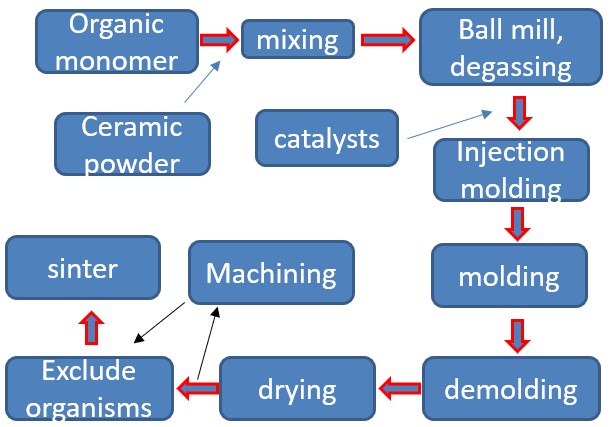
The highlights of Gel injection molding
(1) Strong ability to apply ceramic powder, no special requirements for powder;
(2) Near-net size molding can be realized, large-size and complex shapes and wall thickness parts can be prepared, and a variety of materials can be selected for the mold;
(3) The molding cycle is short, and the wet blank and dry blank strength is high, which is better than the blank made by the traditional molding process, and can be mechanically processed;
(4) Low content of organic matter in the body;
(5) Good uniformity of the performance of the blank and sintered body;
(6) The process is easy to control;
(7) The process and operation are relatively simple, the equipment is simple, and the cost is low.
Shortcomings of Gel Injection Molding
(1) Defects such as bubbles and cracks may occur during the molding and drying process;
(2) Toxicity of organic monomers.
Apply for:
Coarse particle system ceramics, advanced refractory materials, ceramic composites, structural ceramics, high precision structural ceramic components, functional and bioceramics, porous materials, and powder metallurgy.