

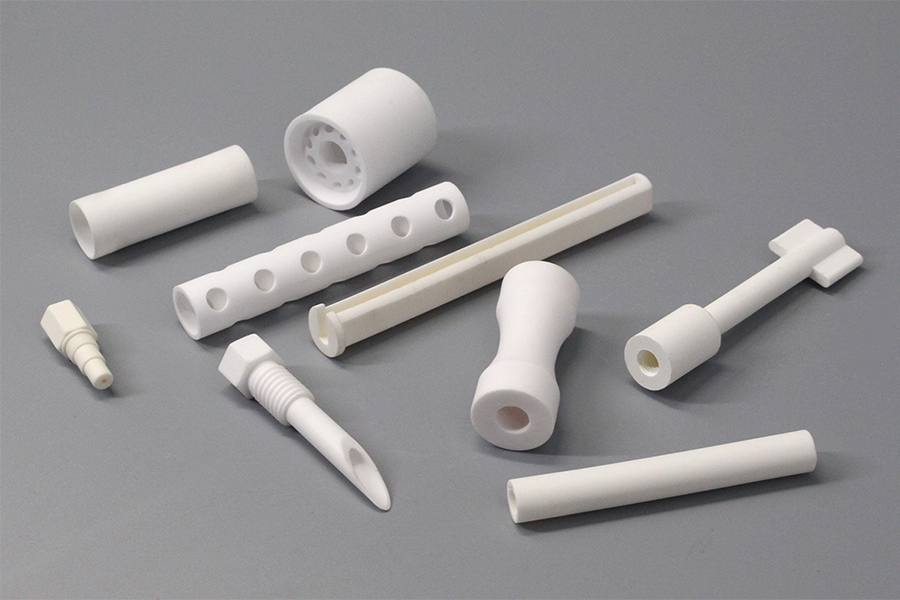
Primary Strengths
● Distinguished wear resistance and ultra-long service life:
The parameter of alumina is approximately 266 times that of manganese steel and 171.5 times that of high-chromium cast iron.
● Superb high-temp stability and thermal performance:
Alumina with a purity of more than 99.5% has a long-term operating temperature of more than 1700°C in air.
● Extremely high hardness and mechanical strength:
The Mohs hardness of high-purity alumina is second only to diamond (10) and boron carbide (9.5~10).
● Excellent electrical insulation and dielectric strength:
Used as electrical insulators and bracket materials in various harsh environments with high temperature and high voltage scenes.
● Ideal chemical inertness and low erosion level:
Resistant to corrosion by most acids, alkalis, and molten metals, suitable for clean or corrosive environments such as chemical, semiconductor, and medical.
● Outstanding cost-effectiveness and customization flexibility:
Compared with other high-performance ceramics (such as zirconium oxide and silicon nitride), alumina provides unparalleled cost-effectiveness while providing the above-mentioned excellent performance combination. At the same time, it is easy to process into complex customized shapes through a variety of molding processes (dry pressing, isostatic pressing, ceramic injection molding) and precision machining, as shown in Figure 2.

Figure 2: Alumina Ceramic Machining
Alumina Types & Grades
Alumina is an amphoteric substance due to its inherent allomorphism. The most prominent and representative crystalline forms are α-alumina and γ-alumina. α-alumina products are dense, stable, ultrahard, and extremely inert. Representative products include corundum, ruby, and sapphire. γ-alumina has a loose, porous structure, a large surface area, and a metastable state, which can be considered "activated carbon.
The following are the five core classification factors of alumina ceramic grades:
1. Purity of alumina
It is the most core and most common grading standard for alumina in the industry. According to purity, alumina can be divided into the following grades:
|
Grade |
Purity |
Characteristics |
Applications |
|
Industrial |
85% - 95% |
High mechanical strength and cost-effectiveness |
Widely used in wear parts, sealing rings, and liners |
|
Standard advanced |
96% - 99.5% |
Excellent insulation, wear resistance, and corrosion resistance |
It is the first choice for electronic substrates, insulators, and precision ceramic components. |
|
High purity grade |
99.8% - 99.99% |
Excellent corrosion resistance, ultra-high insulation resistance, and excellent optical properties |
For demanding semiconductor, medical, and high-end laboratory equipment |
Generally speaking, the higher the purity of alumina, the better its electrical, chemical, and high-temperature properties, but the material cost and processing difficulty also increase accordingly.
2. Additives and microstructure
In many specific applications, other metal oxide powders are added to alumina in designated proportions to achieve or enhance detailed properties. For example:
|
Typical additive |
Purpose |
|
Magnesium Oxide (MgO) |
Inhibit excessive grain growth, improve densification, and enhance mechanical strength and thermal stability. |
|
Chromium Oxide (Cr2O3) |
Improves hardness and wear resistance |
|
Zirconium Oxide (ZrO2) |
Through phase transformation toughening, it significantly improves fracture toughness and thermal shock resistance, while also increasing hardness and wear resistance. |
|
Titanium Carbide (TiC) |
Significantly improves hardness and wear resistance, enabling the cutting tools and wear-resistant components for use in extreme working conditions. |
|
Mullite (3Al2O3·2SiO2) |
Its low coefficient of thermal expansion contributes to improved thermal shock resistance. |
As a solution provider of alumina ceramic components, we can precisely control performance by adding specific substances.
3. Density and porosity
These two factors will directly affect the compactness, mechanical strength, and dielectric properties of the material. The classification is based on the following:
● High-density alumina: Achieved through processes such as isostatic pressing, used in scenarios requiring high strength and integrity.
● Controllable porous type: Specially designed for applications such as filtration, catalytic carriers, or self-lubricating bearings.
4. Molding and processing technology
The manufacturing process determines the shape, dimensional accuracy, and ultimate performance of ceramic parts. Here are some common processes:
● Typical moldings: Dry pressing, hot pressing, isostatic pressing, ceramic injection molding(CIM)
● Post-processing: Grinding, polishing, CNC milling, glazing, and laser cutting, as shown in Figure 3.
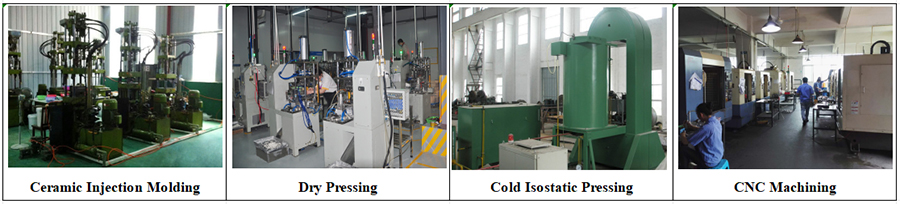
Figure 3: Ceramic moldings and post-processing
5. Main performance indicators
It serves as the ultimate "school report" for verifying the grade of alumina products and is the most trusted quantitative data for users. People focus on the following aspects:
● Mechanical properties: flexural strength, compressive strength, Vickers hardness, yield strength
● Thermal properties: maximum operating temperature, thermal conductivity, thermal expansivity, etc.
● Electrical properties: dielectric strength and volume resistivity, etc.
Alumina Ceramic Material Properties
Physical
| Item | Unit | 99.8% al2o3 | 99.5% al2o3 | 99% al2o3 | 96% al2o3 |
| Density | g/cm3 | ≧3.92 | ≧3.90 | ≧3.85 | ≧3.65 |
| Hardness | GPa | 14.1 | 14.1 | 13.7 | 11.5 |
| Tensile strength | MPa | 279 | 262 | 248 | 221 |
| Compressive strength | MPa | 2650 | 2240 | 2240 | 2000 |
| Flexural Strength @ 25℃ | MPa | 390 | 379 | 338 | 320 |
| Fracture Toughness | MPam1/2 | 4~5 | 4~5 | 4~5 | 3~4 |
| Elastic modulus | GPa | 380 | 370 | 350 | 303 |
Thermal
| Item | Unit | 99.8% al2o3 | 99.5% al2o3 | 99% al2o3 | 96% al2o3 |
|
Thermal conductivity
@ 25℃
|
W/m.k | 31 | 30 | 29 | 24 |
| Specific heat capacity | J.kg*k @100℃ | 780 | 780 | 780 | 780 |
|
Thermal expansion coefficient
@ 25℃ to 700℃
|
10-6/K | 6.5~8.2 | 6.5~8.0 | 6.2~8.0 | 5.0~8.0 |
| Thermal shock | ℃ | ≧200 | ≧200 | ≧200 | ≧220 |
|
Max. service temperature
(In the air)
|
℃ | 1750 | 1650 | 1600 | 1450 |
Electrical
| Item | Unit | 99.8% al2o3 | 99.5% al2o3 | 99% al2o3 | 96% al2o3 |
|
Dielectric strength
@ 25℃
|
KV/mm | 20 | 19 | 18 | 18 |
| Dielectric constant @1MHz | (E) | 9.8 | 9.7 | 9,5 | 9.5 |
| Dielectric loss @ 25℃ | 1MHz | <0.0001 | 0.0001 | 0.0002 | 0.0002 |
|
Volume resistivity
@ 25℃
|
ohm. cm | >1* 1014 | >1* 1014 | >1* 1014 | >1* 1014 |
Alumina Applications
Alumina plays a vital role in modern industry. With its high hardness, excellent wear resistance, outstanding insulation performance, stable chemical properties, and good thermal properties, it is indispensable in many key areas.
1. Electrical and Semiconductors
In the world of microelectronics, even minute impurities or dimensional shifts can cause failure. Alumina ceramic substrates, insulators, and packages provide a pristine, stable, and reliable platform.
2. Industrial Automation & Wear Parts
Where components face constant abrasion, impact, and friction, alumina ceramics dramatically reduce wear and maintenance costs.
3. Medical & Biotechnology
Alumina's biocompatibility, sterilizability, and corrosion resistance make it ideal for critical medical devices and tools.
4. Automotive & Transportation
From sensors to seals, alumina components ensure performance under the hood and within advanced vehicle systems.
5. Energy & Chemical Processing
In chemical plants and energy production facilities, alumina ceramics stand up to aggressive media and high temperatures where other materials corrode or degrade
6. Aerospace
In the demanding world of aerospace, alumina ceramics are vital for components that must withstand extreme heat and wear. They are extensively used in thermal insulation systems for engines, high-performance radomes for clear signal transmission, and as critical wear-resistant parts in fuel and guidance systems.
These are just a glimpse. The true potential of alumina is unlocked through custom engineering. Have a challenging application where performance is critical? Please get in touch with our engineering team to explore a tailored alumina ceramic solution.
Conclusions
Understanding aluminum oxide's potential is the first step. The critical next step is partnering with a supplier who can transform this material into a reliable, cost-effective solution for your unique challenge. Leverage our expertise in advanced alumina ceramics to solve your most demanding challenges in wear, heat, and corrosion.
Ready to optimize your design and reduce TCO? Contact our engineers today for a free, no-obligation project review and discover how our precision-crafted alumina solutions can give you a critical competitive edge.
Frequently Asked Questions
1. Is alumina an element?
No, alumina is not an element. It is a chemical compound.
This is a common point of confusion because its name contains "aluminum." Here's the simple breakdown:
❉ An Element is a pure substance made of only one type of atom (e.g., pure aluminum metal).
❉ A Compound is a substance formed when two or more different elements are chemically bonded together.
2. What color is alumina?
The color of alumina ceramic is a direct indicator of its impurities and metallic oxide additives, offering a quick visual cue for material selection.
|
Type of additives and purity |
Color |
Features |
|
Purity ≧ 99% |
Ivory or pure white |
Exceptional electrical insulation, wear resistance, and chemical stability |
|
Chrome Oxide (Cr2O3), Purity≈94.4% |
Pink, rose, or red |
Enhance wear resistance |
|
Manganese Oxide (MnO₂) Purity≈92% |
Black |
Suitable for applications where aesthetic or light-insensitive properties are needed. |
3. What is the formula for aluminum oxide?
The chemical formula for aluminum oxide is Al₂O₃.
This signifies that each molecule is composed of two aluminum (Al) atoms ionically bonded to three oxygen (O) atoms. This stable, crystalline structure is the foundation of what we know industrially as alumina ceramic.
4. Is alumina toxic?
In its solid, sintered ceramic form—as used in industrial components—alumina is generally considered non-toxic, biocompatible, and safe for most applications.
This safety profile is confirmed by its widespread use in medical implants and as an indirect food contact substance approved by regulatory bodies like the FDA.
5. What is the name for AL2O3?
The most common and recognized name for Al₂O₃ is Alumina, which is the term preferred in industrial and materials science contexts.