

What is Zirconia
Zirconia (ZrO2) is one of the most widely studied and used advanced ceramic materials. Compared with other technical ceramic materials, the most prominent feature of zirconia is its extremely high fracture toughness, which makes it have super wear and impact resistance, so it is also named "ceramic steel."
Low thermal conductivity is another unmatched property of zirconia ceramics, attributed to its many microscopic pores and crystal structure. This particular ceramic crystalline structure gives zirconia an excellent thermal insulation effect.
The Structure of Zirconia (ZrO2)
Zirconia ceramics have three different phases due to temperature changes, which are:
※ From room temperature to 1170℃, it is monoclinic (M-ZrO2) phase;
※ Between 1170℃ and 2370℃, it is transformed into tetragonal (T-ZrO2) phase;
※ When the temperature exceeds 2370℃, it is transformed into a cubic (C-ZrO2) phase.
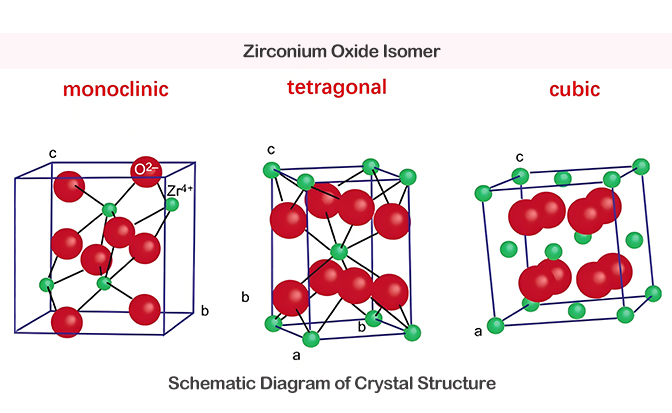
The three phases of ceramic zirconia can be transformed into each other at different temperatures. The same zirconia ceramic parts with different phases have various sizes, volumes, and mechanical and chemical properties.
Other Advantages of Zirconia (ZrO2)
※ High strength: The compressive strength can reach over 1000MPa, above 5 times that of steel.
※ High-temperature resistance: The service temperature of zirconia can be up to 1000℃
※ High density: It’s a highly dense ceramic material, the density is up to 6.1 g/cm3
※ High hardness: The MoHS of zirconium oxide ceramic hardness is up to 8.5, similar to sapphire
※ Corrosion resistance: ZrO2 doesn’t react with most acids, alkalis, salts, and other chemicals
※ Resistant crack propagation: It’s the real cause of why zirconia zro2 ceramic has superb fracture toughness.
※ Self-lubricity: Zirconium oxide ceramic has a much lower friction coefficient; it’s only ½ of alumina ceramics
※ More Fine Surface: The much higher density and high compactness of zirconium oxide make the texture of the ceramic body fine
※ Resistant to molten metal: ZrO2 ceramic is not easily wetted by liquid metal, so it is highly resistant to corrosion in molten metal.
※ Electrical Insulation: ZrO2 ceramic has a high resistivity at room temperature and can be used as a ceramic insulator, but when the operating temperature exceeds 650℃, it will become an electrical conductor.
Types of zirconia materials
Doped with different stabilizers have a significant impact on zirconia materials. According to the main categories of stabilizers, zirconia ceramics can be divided into three types:
1. Yttria stabilized zirconia (YSZ)
Zirconia (ZrO2) material was prepared by adding 3 mol of yttrium dioxide called yttria, which is partially stabilized zirconia. YSZ zirconia presents a stable tetragonal crystal structure at room temperature and has high strength, corrosion resistance, high-temperature resistance, good biocompatibility, wear resistance, and good ionic conductivity. With the increase of Y2O3 content, stabilized zirconia ceramics can be transformed from tetragonal phase (partially stabilized) to cubic phase, that is, fully stabilized zirconia (FSZ)
2. Magnesium stabilized zirconia (MSZ)
Adding an appropriate amount of magnesium oxide to zirconium oxide can adjust its performance. Magnesium-stabilized zirconia has good mechanical strength, thermal stability, and chemical stability.
3. Cerium-stabilized zirconia (CSZ)
This toughened ceramic is made by using cerium oxide as a stabilizer, uniformly doped in zirconia at a molecular content of 8% to 16%.
Zirconia Ceramic Material Properties
Electrical Properties
| Property | Unit | 3Y-TZP | MSZ | Ce-TZP |
| Dielectric strength | ac - KV/mm | 11.7 | 9.4 | 9.8 |
|
Dielectric constant
@ 1MHz
|
(E) | 29 | 28 | 29.2 |
|
Dielectric loss
@ 1MHz
|
--- | 0.001 | 0.0018 | - |
| Volume resistivity, 25℃ | ohm. cm | 1*1013 | 1*1013 | 1*1013 |
| Volume resistivity, 500℃ | 1*107 | 1*107 | 1*107 | |
| Volume resistivity, 1000℃ | <1*103 | <1*103 | <1*103 |
Thermal Properties
| Property | Unit | 3Y-TZP | MSZ | Ce-TZP |
| CTE @ 25~1000℃ | 10-6/℃ | 10.3 | 10.2 | 10.3 |
|
Thermal Conductivity
@ 25℃
|
W/m.K | 2.2 | 3 | 3.5 |
|
Specific Heat
@ 100℃
|
J/kg*k | 400 | 400 | 400 |
| Max. Service Temperature (Without loading) | ℃ | 500 | 1200 | 530 |
Physical Properties
| Property | Unit | 3Y-TZP | MSZ | Ce-TZP |
| Density | g/cm3 | ≧6.0 | ≧5.72 | ≧6.1 |
| Hardness | GPa | 12.7 | 11.8 | 10 |
| Flexural strength @ 25℃ | MPa | 1200 | 900 | 551 |
| Fracture toughness | MPam1/2 | 13 | 11 | 15 |
| Tensile strength (3 point) @ 25℃ | MPa | 690 | 483 | 337 |
| Compressive strength @25℃ | MPa | ≧2480 | ≧1750 | ≧2000 |
| Elastic modulus | GPa | 210 | 200 | 180 |
| Poisson’s ratio | -- | 0.30 | 0.30 | 0.25 |
Applications of Zirconia Ceramics
1. Typical Applications of YSZ Zirconia
YSZ zirconia is the most widely used of all zirconia categories. Its applications include:
※ Ceramic wear parts
※ Zirconia ball valves and seats
※ Pump seals and shaft bearings
※ Solid oxide fuel Cell (SOFC)
※ Precision ZrO2 ceramic nozzles
※ Ceramic cutting tools and blades
※ Oxygen sensor, nitrogen oxide sensor
※ Ceramic rollers and guides for wire forming
※ Ceramic thread and yarn guides for textile machinery
※ Functional ceramics and structural ceramic components
2. Typical Applications of MSZ Zirconia
※ Engineering applications: mechanical seals, stamping & extrusion dies and wear parts
※ Optical communication device: ceramic sleeves, ceramic capillary, ceramic holders
※ Biomedical science: bone tissue repair materials, biosensors, Fracture internal fixator, and drug carriers
※ Refractories: high-temperature furnace parts, ceramic parts for aerospace engines, and structural materials for spacecraft
3. Typical Applications of CSZ Zirconia
※ Grinding medium: Suitable for grinding all kinds of high-viscosity materials
※ Structural ceramic parts: mainly used in high hardness, high-temperature resistance occasions
※ Automotive catalytic systems: Ceria stabilized zirconia as a catalyst carrier can improve catalytic efficiency and reduce pollutant emission
Final Thoughts
Thanks to its excellent mechanical and thermal properties, chemical inertness, and high-temperature stability, the use of zirconia ceramics will be further deepened and expanded with the innovation of science and technology and the continuous improvement of production processes, moving towards higher performance, more diversified functions, and low cost of the advanced ceramic material.