

Introduction
Ceramic substrates are a base material typically used in power modules for thermal management, offering electrical insulation and mechanical support. Due to the ideal inherent combination of high thermal conductivity, high-voltage and current insulation properties, mechanical strength, and corrosion resistance, the performance and reliability of devices, such as power electronics and high-temp packaging ceramics, with ceramic substrates are significantly optimized.
Ceramic Substrate Advantages
When you choose ceramic substrates, they will repay you and bring many benefits, primarily including
※ Offering quick high-heat transfer and dissipation because of its high thermal conductivity
※ Owning low thermal expansivity with temperature fluctuations with mounted chips
※ Possessing friendly bonding capability with multifarious metals via specific media
※ Supplying excellent insulation breakdown, ideal for various high-voltage, high-current circumstances
※ Providing superior chemical stability and inertness, it will not react with most acids, alkalis, and salts in the air and never oxidize.
Types of Ceramic Substrates
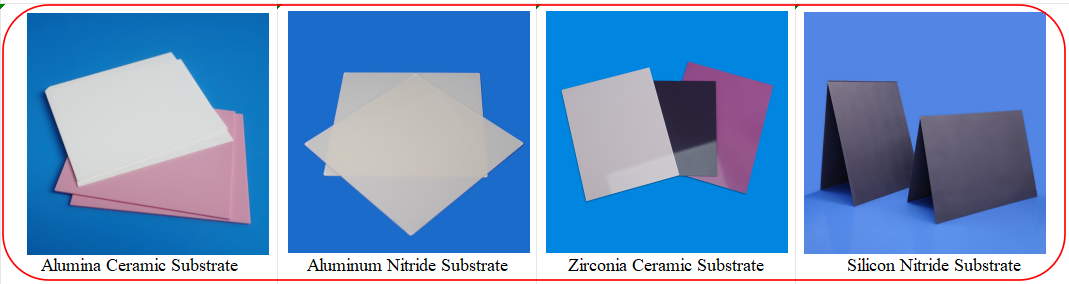
Ceramic substrates are made from a variety of advanced ceramic materials. According to the categories of raw materials used in most practical applications, they can be mainly classified into the following types:
.
1. Alumina Al2O3 Ceramic Substrate
It is the most commonly used ceramic substrate because of its cost-effectiveness. It holds an above-80 % share in the ceramic substrate market.
2. Aluminum Nitride Aln Substrate
Aluminum nitride substrate is featured by its fabulous thermal conductivity up to 180W/m.k at room temperature.
3. Silicon Nitride Si3N4 Substrate
Silicon nitride substrate is known for its superb bending strength and high thermal shock resistance among ceramic substrates.
4. Zirconia ZrO2 Ceramic Substrate
Zirconia ceramic substrate is characteristic of its super-high fracture toughness and distinctive thermal isolation properties.
5. Beryllia Oxide BeO Ceramic Substrate
It is a ceramic substrate that people both like and hate. Some love its ultra-high thermal conductivity, but others hate it because of its high toxicity during powder preparation.
Ceramic Material Properties Comparison
Different ceramic substrate materials exhibit unique properties to achieve designated needs and functional requirements in numerous industries, and you can discover some information below for deciding on a choice in your specific cases:
| General | Properties | Unit | Material | |||||
| Al2O3 | AlN | Si3N4 | ZrO2 | BeO | ||||
| Purity | -- | % | ≧96% | ≧99.5% | ≧99.6% | ≧96% | ≧96% | ≧99.6% |
| Density | -- | g/cm3 | 3.75 | 3.90 | 3.25 | 3.18 | 6.0 | 2.90 |
| Thermal | Thermal Conductivity@ 25℃ | W/m.k | 20 | 30 | 180 | 80 | 3 | 310 |
| CTE @ 25℃ ~ 400℃ | 10-6/K | 7.2 | 7.4 | 4.4 | 3.2 | 7.8 | 7.5 | |
|
Specific Heat
@ 25℃
|
J/(㎏・K) | 750 | 780 | 720 | 700 | 460 | 840 | |
| Electrical | Volume resistivity | Ohm. cm | ≧1014 | ≧1014 | ≧1014 | ≧1014 | ≧1014 | ≧4*1010 |
| Dielectric constant | 1MHz | 9.4 | 9.8 | 9 | 4 | 33 | 6~7 | |
| Dielectric loss factor | 10-3 | ≦3 | ≦1 | ≦2 | -- | ≦16 | ≦0.4 | |
| Insulation breakdown @DC | KV/mm | ≧15 | ≧15 | ≧15 | ≧100 | ≧10 | ≧10 | |
| Mechanical | Bending strength | MPa | >350 | >500 | >400 | >800 | >800 | >310 |
| Modulus of elasticity | GPa | 340 | 300 | 320 | 320 | 200 | 350 | |
| Vickers hardness | GPa | 14 | 16 | 11 | 15 | 11 | 9 | |
| Fracture toughness | MPa.m1/2 | 3.0 | -- | 3.0 | 6.7~8 | 5.0 | 3.5~4.5 | |
| Others | Toxicity | -- | None | None | None | None | None | Toxic |
Uses of Ceramic Substrates
※ Alumina Ceramic Substrates
Due to the characteristics of high-purity alumina substrates, which have relatively low thermal conductivity and high thermal expansion coefficient, are primarily used in automotive electronics, semiconductor lighting, and electrical equipment.
※ Aluminum Nitride Substrates
Because aluminum nitride ceramic material has high thermal conductivity and thermal expansion coefficient, in addition to its high insulation strength and low dielectric constant, it is an ideal packaging substrate and heat dissipation material.
※ Silicon Nitride Substrates
Given the high mechanical strength, high thermal conductivity, and thermal shock resistance of silicon nitride (Si3N4) ceramics, Si3N4 substrates are widely used in high-power semiconductors, high-end equipment, new energy vehicles, and aircraft engines.
※ Zirconia Ceramic Substrates
Considering that zirconia (ZrO2) ceramics have excellent mechanical properties, thermal insulation, refractive index, and wide spectral transparency, they are widely used in industry, electronics, optics, and medicine.
※ Beryllia Ceramic Substrates
Beryllium oxide substrates have low density, extremely high thermal conductivity, and good comprehensive performance. However, BeO powder is highly toxic and expensive, so it is only used in a few fields, such as high-power, high-frequency semiconductor devices, avionics, and satellite communications.
Final Thoughts
In a word, the application of ceramic substrates has covered almost all high-end electronic power and even communications, computers, military, and aerospace fields. With the innovation and progress of technologies in various application fields, the global ceramic substrate market will grow substantially.
With continuous breakthroughs in ceramic substrate powder purification technology and the improvement of molding and ceramic metallization processes, ceramic substrates will develop towards thinner, higher performance, higher reliability, and higher integration.