

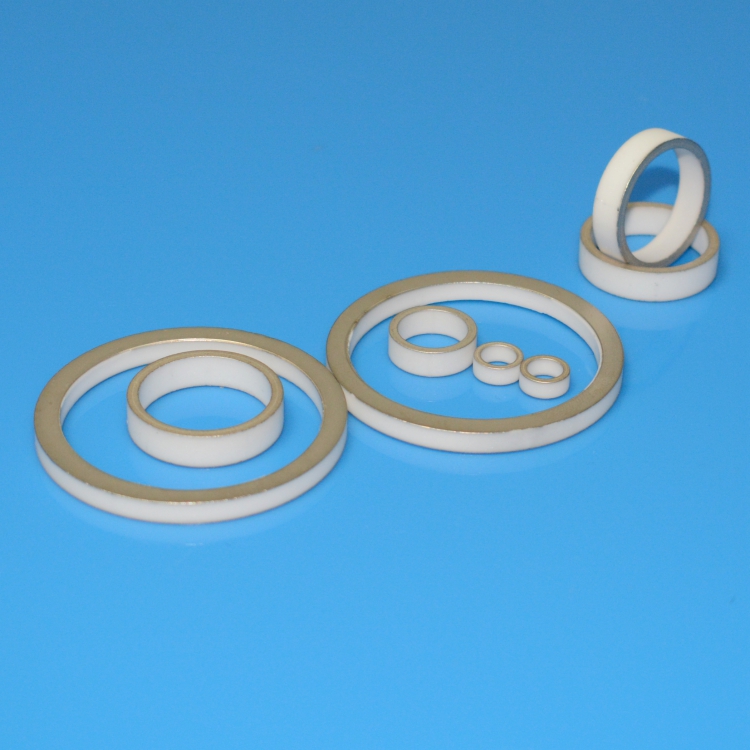
Metallized ceramic rings are composite components made from a technical ceramic (primarily composed of 95% or 99% alumina) using specialized processes (such as sintering a molybdenum/manganese metal layer followed by nickel plating, or direct silver plating or tungsten metallization followed by gold plating). They combine the insulation and heat resistance of ceramic with the conductivity and solderability of metal, playing a key role in insulators and sensor elements.
Key Features of Metallized Ceramic Rings
Excellent Adhesion Strength
Through metallization processes such as sintering molybdenum/manganese (Mo-Mn) layers, the ceramic and metal layers form a strong metallurgical bond, withstanding mechanical stresses in high-pressure and high-temperature environments and preventing peeling or cracking due to differences in thermal expansion coefficients.
Excellent Sealing and Airtightness
After the metallized layer is bonded to the ceramic substrate, surface flatness can reach micrometers. Combined with nickel or gold plating, they effectively prevent gas or liquid leakage, meeting the sealing requirements of vacuum equipment and high-pressure vessels.
High Insulation and Corrosion Resistance
Alumina ceramics have a volume resistivity as high as 10⁴-10⁶ Ω·cm. Combined with the oxidation resistance of metal coatings (such as silver), they can operate stably and long-term in humid and corrosive environments, preventing short circuits or insulation failure.
Thermal Shock Resistance and Low Thermal Conductivity
Alumina ceramics have a thermal expansion coefficient (7.2×10⁻⁶/°C) close to that of metals (e.g., molybdenum: 5.1×10⁻⁶/°C), reducing thermal stress. Furthermore, their low thermal conductivity (30 W/m·K) isolates high temperatures and protects internal components.
Applications and Functions in Insulators
High-Voltage Electrical Insulation
In power equipment (such as transformers and circuit breakers), metallized ceramic rings serve as core insulator components. Their high volume resistivity isolates the high-voltage electrode from the grounding component, preventing arcing. For example, in high-voltage bushings above 110 kV, their dielectric strength can reach over 20 kV/mm.
Mechanical Support and Sealing
The metallized layer of the ceramic ring can be welded to metal components such as flanges and bolts to form a rigid structure. The airtight design also prevents moisture and contaminants from entering, extending the life of the device.
Environmental Corrosion Resistance
In outdoor or chemical environments, the corrosion resistance of the metallized ceramic ring protects against salt spray, acid rain, and other corrosion-prone environments, preventing degradation of insulation performance and reducing maintenance frequency.
Applications and Functions in Sensor Components
Structural Support and Signal Isolation
In pressure and temperature sensors, ceramic rings serve as a base, securing sensitive components (such as piezoelectric chips and thermistors) while insulating the metal housing from signal lines to prevent interference.
Thermal Management and Protection
The low thermal conductivity of ceramics mitigates the impact of external temperature fluctuations on the sensor's interior, while the metallized layer (such as gold plating) quickly dissipates heat generated by the component, ensuring stable operation. For example, in automotive engine sensors, ceramic rings must withstand temperature fluctuations ranging from -40°C to 150°C.
Miniaturization and High-Precision Machining
Through precision processes such as surface grinding and cylindrical grinding, ceramic rings can be machined to miniature sizes of 0.5mm in diameter and 0.1mm in wall thickness, meeting the integration requirements of MEMS sensors while maintaining a tolerance of ±0.005mm.
Manufacturing Capabilities and Customization Advantages
Flexibility in Size and Configuration
Production capabilities range from micro sensor components (diameter <1mm) to large insulators (diameter >200mm), supporting customization of complex structures such as irregular holes and stepped grooves.
Various Metal Plating Options
In addition to standard nickel plating, silver plating (for improved conductivity), gold plating (for enhanced corrosion resistance), or tungsten metallization (for high-temperature applications) can be provided upon request to suit diverse application environments.
Quick Response from Prototype to Mass Production
Combining CNC machining with automated production lines enables large-scale mass production.
FAQs (Frequently Asked Questions)
Q1: Can customized products be provided?
A: Absolutely. We offer comprehensive support for tailor-made solutions, including customization of dimensions, designs, metallization methods, and plating options to meet your specific requirements.
Q2: How soon can I receive a price quote?
A: We typically provide a detailed quotation within 24 hours after receiving your inquiry, ensuring prompt and transparent communication.
Q3: What is the estimated timeline for completing the entire production process?
A: Once your order is confirmed, the manufacturing cycle takes approximately 25 working days, depending on product complexity and order volume.
Q4: What are the transportation options and delivery timelines?
A: We primarily arrange shipments via international express services through our trusted forwarders, or using your designated account number. Delivery typically takes 3–5 working days, subject to the destination and shipping method.
Q5: How do you guarantee product quality?
A: We adhere to strict quality control protocols:
Sampling Inspection: Each production batch undergoes dimensional checks based on the International AQL Standard to ensure compliance.
100% Cosmetic Inspection: Every unit is visually inspected for surface defects, finishes, and overall appearance before shipment.