

Honeycomb ceramics are a structure made of porous ceramic materials, with regular honeycomb channels inside (similar to honeycombs), which have high specific surface area, low density, high temperature resistance, thermal shock resistance and other characteristics. They are widely used in environmental protection, energy, chemical industry, metallurgy and other fields. The following are its core characteristics and typical application scenarios:
Core characteristics of honeycomb ceramics
High specific surface area
The honeycomb structure provides a large number of open channels, and the surface area per unit volume far exceeds that of ordinary ceramics (up to 1000-2000 m²/g), which significantly improves the efficiency of catalytic reactions.
Excellent thermal insulation performance
The porosity is as high as 60%-90%, and air fills the pores to form an insulation layer. The thermal conductivity is as low as 0.1-0.3 W/(m·K), which is suitable for heat preservation in high temperature environments.
Lightweight and high strength
The density is only 1/3-1/2 of traditional ceramics (0.3-0.8 g/cm³), while maintaining a high compressive strength (up to 10-50 MPa).
High temperature resistance and thermal shock resistance
Can withstand high temperatures of 800-1600℃ for a long time, with a low thermal expansion coefficient (1-5×10⁻⁶/℃), reducing the risk of cracking caused by temperature changes.
Chemical corrosion resistance
It has good stability to acids, alkalis, organic solvents, etc., and is suitable for harsh chemical environments.
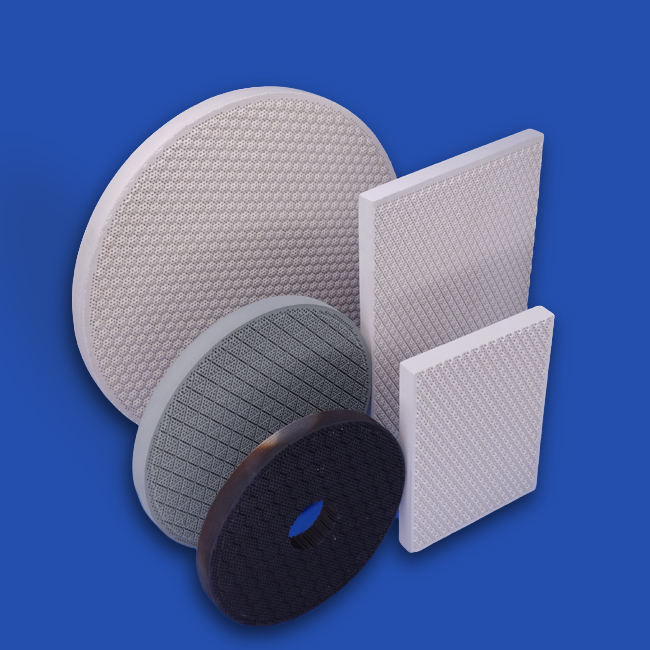
Typical application areas of honeycomb ceramics
Automobile exhaust treatment (core application)
Three-way catalytic converter (TWC):
Honeycomb ceramics are used as carriers, coated with precious metal catalysts such as platinum (Pt), palladium (Pd), and rhodium (Rh) to convert CO, HC, and NOx in exhaust gas into CO₂, H₂O, and N₂.
Advantages: High specific surface area improves catalytic efficiency, and low thermal expansion coefficient prevents high temperature cracking.
Diesel particulate filter (DPF):
The honeycomb pores intercept carbon particles (PM2.5) in diesel vehicle exhaust and remove carbon deposits through regular regeneration (high temperature combustion).
Case: Ceramic honeycomb DPF is widely used in vehicles that meet the National VI emission standard, reducing particulate matter emissions by more than 80%.
Industrial flue gas purification
SCR denitration catalyst carrier:
Used for flue gas denitration (selective catalytic reduction) in coal-fired power plants and steel plants, honeycomb ceramics are loaded with V₂O₅-WO₃/TiO₂ catalysts to reduce NOx to N₂.
RTO heat storage body:
In the regenerative thermal oxidizer (RTO), honeycomb ceramics store the heat of combustion exhaust gas and are used to preheat the newly incoming exhaust gas, with an energy saving efficiency of more than 95%.
Energy and chemical industry
Infrared radiation combustion plate:
The surface of honeycomb ceramics is coated with infrared coating, which radiates infrared rays during combustion to improve thermal efficiency (such as gas stoves, industrial heating furnaces).
Chemical reaction carrier:
As a catalyst carrier for fixed bed reactors, it is used in chemical processes such as methanol synthesis and Fischer-Tropsch synthesis to improve reaction selectivity.
Powder metallurgy sintering plate:
Carrying metal powder compacts, uniform heat transfer during high-temperature sintering to prevent deformation and cracking.
High temperature insulation material
Kiln insulation layer:
Used for the lining of industrial kilns (such as ceramic kilns and glass melting furnaces) to reduce heat loss and save 20%-30% energy.
Emerging field expansion
Fuel cell electrolyte carrier:
In solid oxide fuel cells (SOFCs), honeycomb ceramics are used as electrolyte supports to improve ion conduction efficiency.
Water treatment filter material:
Honeycomb ceramics loaded with photocatalysts are used for sewage purification to decompose organic pollutants through light.