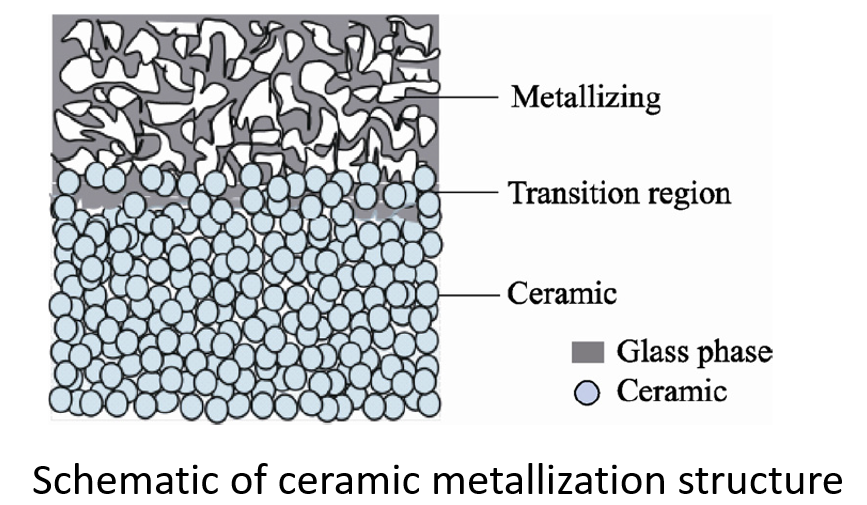
With the ongoing advancement of advanced ceramics, particularly electronic ceramics, the connection between ceramics and metals has become a focal point of interest. However, the distinct microstructures of ceramic and metal surfaces pose challenges for direct bonding. Traditional solders fail to adequately wet ceramic surfaces, preventing effective adhesion. To address this, ceramic metallization techniques have been developed. These methods involve depositing a firmly adhering metal film onto the ceramic surface, enabling successful welding between ceramics and metals.
Principle of Ceramic Metallization
Ceramic metallization involves a series of chemical and physical reactions, including plastic flow of substances and particle rearrangement. During sintering, various substances in the metallization layer, such as oxides and non-metallic oxides, undergo chemical reactions and diffusion. As temperature increases, these substances form intermediate compounds, which reach a common melting point to create a liquid phase. The viscous liquid glass phase undergoes plastic flow, and particles rearrange under capillary action. Surface energy drives atomic or molecular diffusion, promoting grain growth and reducing porosity, ultimately achieving densification of the metallization layer.
Process Classification of Metallized Ceramics
This discussion focuses on metallization techniques for advanced ceramic components, excluding ceramic substrates.
Burnt Silver Method (Silver Infiltration)
This method involves infiltrating a layer of metallic silver onto the ceramic surface. Silver's excellent conductivity and oxidation resistance allow direct welding of metals to the silver layer. However, silver is prone to diffusion into the medium under high temperatures, humidity, and DC electric fields, making it unsuitable for environments with stringent electrical performance requirements.
Process Flow:
Pre-treatment: Ceramics are cleaned in soapy water at 70–80°C, rinsed, and dried at 100–110°C. Ultrasonic cleaning may also be used.
Silver Paste Preparation: Silver-containing raw materials, flux, and binder are mixed in a corundum ball mill for 70–90 hours to achieve uniformity and fineness.
Coating: Silver paste is applied manually, mechanically, via dip coating, spraying, or screen printing. Solvents like turpentine may be added to adjust viscosity.
Drying and Sintering: The silver layer is dried at 60°C to prevent scaling, then sintered in a box-type electric furnace or tunnel kiln.
Sintered Metal Powder Method
This technique involves sintering metal powder onto the ceramic surface under a high-temperature reducing atmosphere to form a metal film.
Key Considerations:
The melting point of the metal to be welded should exceed the metallization temperature by at least 200°C.
The thermal expansion coefficients of the metal and ceramic should be closely matched.
Metal Powder Selection:
Refractory metals (e.g., W, Mo) are used as the primary powder, with small amounts of lower-melting-point metals (e.g., Fe, Mn, Ti) added.
The Mo-Mn formula is widely adopted due to its strong adaptability.
Subcategories:
Activator-Added Mo-Mn Method: Activators (e.g., ore powder, porcelain powder) lower the metallization temperature and enhance bonding strength.
Low-Temperature Metallization: Substitutes molybdenum and manganese oxides or salts (e.g., MoO₃, MnO₂) for metal powders, reducing metallization temperatures below 1200°C. This method is convenient for coating deep or small holes but suffers from high migration rates of the metallization layer.
Active Metal Brazing Method
Developed later than the Mo-Mn method, this technique requires fewer steps, completing ceramic-metal sealing in a single heating process. Brazing alloys containing active elements (e.g., Ti, Zr, Hf, Ta) react with Al₂O₃ to form a metallic reaction layer at the interface. While cost-effective and adaptable to large-scale production, its limited range of active brazing materials restricts its application to large, single-piece or small-batch production.
Oxide Solder Method
This method uses mixed oxides (e.g., CaO, MgO, SrO, BaO with SiO₂, B₂O₃, Al₂O₃) as solder for ceramic-metal sealing. The oxides are melted, quenched, and ground into fine powder. This technique is commonly used for sealing high-alumina or transparent alumina ceramics to metals like W, Mo, Ta, and Nb.
Pressure Sealing
At room temperature, mechanical pressure is applied to tightly bond ceramics and metals. This method leverages the high compressive strength of ceramics and the elastic deformation of metals. A small oblique angle (7°–10°) is ground onto the ceramic ring end face, and the ceramic ring (slightly smaller in inner diameter than the metal ring's outer diameter) is pressed onto the metal. The metal ring expands elastically, clamping tightly to the ceramic ring to form a pressure seal with pressures up to 600 MPa.
Applications: This process is suitable for large, low-volume sealing parts, typically high-alumina porcelain. The metal used should have high strength, elasticity, a thermal expansion coefficient similar to the ceramic, and good fatigue resistance. Soft metal plating (e.g., silver, copper, or gold) on the metal sealing surface facilitates sliding during sealing and ensures airtightness.
Sputtering Method Metallization
Conducted in a vacuum system, sputtering involves two-sputtering, four-sputtering, or high-frequency sputtering processes. In two-sputtering, the system is pumped to a high vacuum (10⁻⁵ Pa), filled with argon (1–10⁻¹ Pa), and the ceramic part is placed near the sputtering target. A negative high voltage (1–7 kV) ionizes the argon, and positive ions bombard the target surface, sputtering metal onto the ceramic to form a thin metal film.
Target Configuration: Two or three different metals are mounted on a rotatable shelf. After sputtering the first layer (e.g., tungsten or molybdenum, 50–500 nm thick), the target frame is rotated to sputter a second layer (e.g., copper, silver, or gold, 1–5 µm thick). Using Ti for the first layer yields better results.
Applications: Sputtering is ideal for ceramics that cannot withstand high temperatures (e.g., piezoelectric ceramics) and ensures precise dimensional control due to the thin metallization layer.
Technical Challenges of Metallized Ceramics
Thermal Expansion Mismatch: Differences in thermal expansion coefficients between ceramics and metals can induce stress during sintering, leading to cracking or layer destruction.
Interfacial Chemical Reactions: Reactions at the metal-ceramic interface produce oxides, altering the chemical composition and structure of the interface and degrading performance.
Melting Point Disparity: The significant difference in melting points between ceramics and metals complicates complete fusion, resulting in tiny cracks and defects that reduce sealing strength.
High Cost and Complexity: The expensive and intricate manufacturing process of ceramic metallization limits its application in certain fields.
By addressing these challenges, ceramic metallization continues to evolve, enabling reliable connections between ceramics and metals in advanced electronic and structural applications.